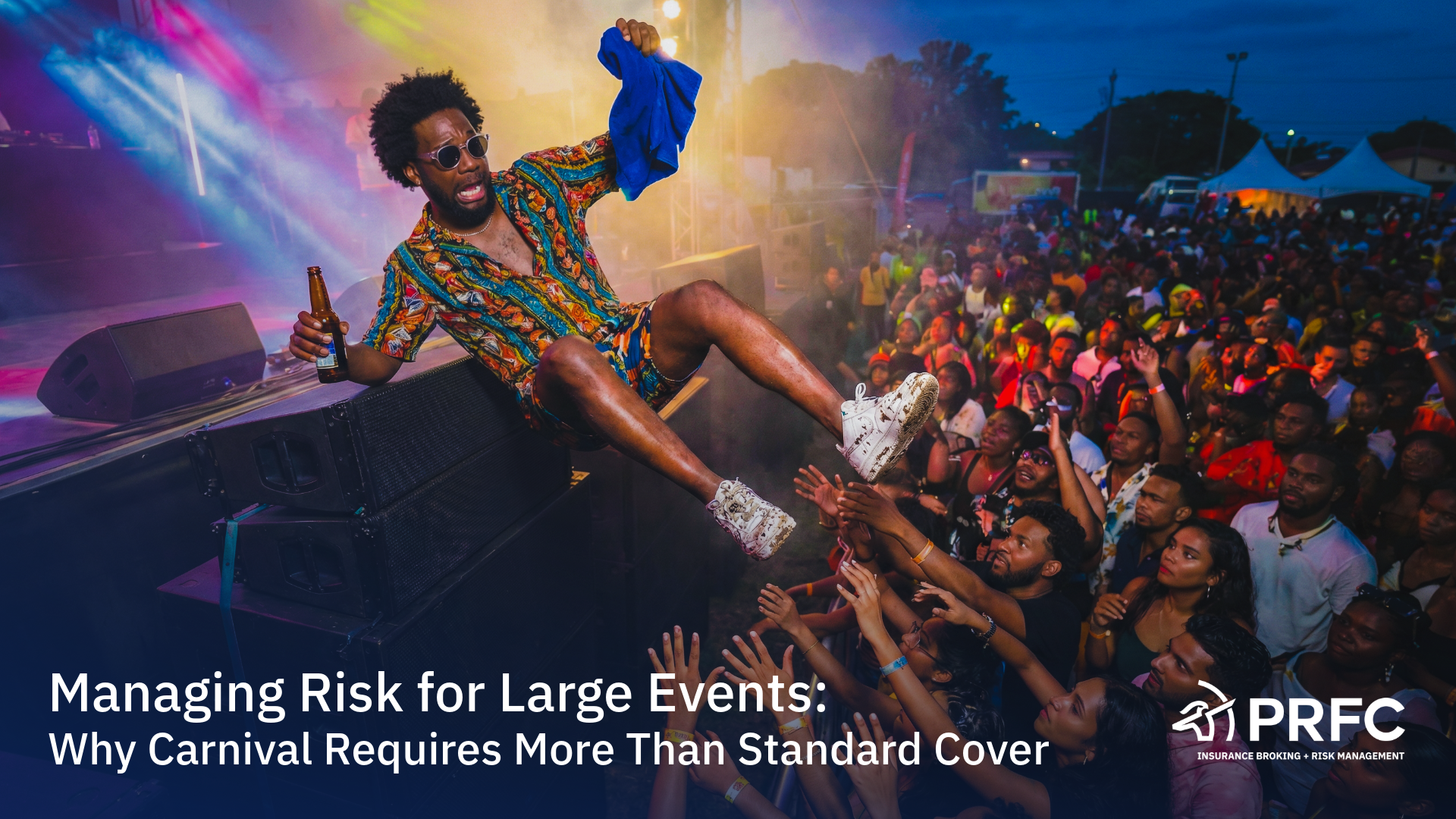
Carnival season in Trinidad and Tobago is one of the most vibrant and economically significant periods on the national calendar. From large-scale fetes and concerts to all-inclusive events and branded activations, the scale, energy, and complexity of Carnival production continues to grow. With that growth comes a critical question that promoters, service providers, and stakeholders must confront: are the risks truly understood, mapped, and appropriately insured?
Carnival events come with unique risk exposures, and cannot be approached as a box-ticking exercise. While many organisers assume that having public liability cover is sufficient, real-world experience in the events and entertainment industry shows that this is not all encompassing and the nuances matter.
Liability is Not Automatic
One of the most misunderstood aspects of event insurance is liability. For a public liability policy to respond, there must be proof of negligence - generally, a failure to do something that a reasonable operator should have done, or doing something that should not have been done. Not every tragic or unfortunate incident automatically creates liability.
For example, event organisers and security providers cannot reasonably be expected to detect every concealed substance or prevent every individual act of wrongdoing in a crowded fete environment. The law and insurers recognise this distinction. Conversely, if an incident arises from a clearly unsafe structure, inadequate staging, or a failure to follow established event safety protocols, liability may attach very differently.
This distinction is often lost in the emotional aftermath of an incident, where public expectation, moral outrage, and contractual reality can collide, sometimes at great financial cost to the promoters, venues and contractors involved.
Contracts and the Law Matter
Carnival has provided multiple reminders over the years that contracts and law, not sentiment, govern outcomes. Ticket terms such as “rain or shine”, force majeure clauses, and clear disclaimers are risk management tools, not legal formalities.
If a major event is disrupted by torrential rain, or if someone is injured at the hands of another patron, promoters may feel moral pressure to “make it right.” Electrical problems and/or infrastructure collapse are issues that may fall on the shoulders of the promoter, the venue owner or the subcontractor. Without carefully drafted contracts and appropriate specialty insurance solutions (such as broad public liability, event cancellation or non-appearance cover), these situations can quickly escalate into disputes, unexpected costs, losses, or uninsured exposures.
This is particularly relevant for international patrons, as well as vendors, performers, and service providers whose brand equity can be adversely affected by an event and whose own contracts may trigger knock-on claims.
Risk Mapping Before the First Ticket is Sold
Effective event risk management begins long before Carnival week. It requires structured risk mapping, including:
- What are the credible risks? (weather, crowd density, alcohol, power supply, equipment failure, licensing)
- Who is responsible for what - legally, contractually and operationally?
- What risks can be mitigated through procedural, contractual or physical controls?
- What risks should be transferred through insurance?
Insurance is the final layer of protection to address the financial consequences following a loss. Careful risk management to reduce loss frequency and severity, a clear understanding of legal obligations, well-drafted contracts, realistic disclaimers, appropriate security planning, and operational controls are equally important. This is where detailed risk mapping is invaluable.
The PRFC Perspective
At PRFC, we approach large event coverage as part of a broader risk strategy, not a standalone policy placement. Our role is to help promoters, contractors, event managers and stakeholders understand where responsibilities start and end, how liability actually attaches, and how measures including specialty insurance for large events can be structured to protect all parties without creating false expectations.
With thoughtful planning, clear contracts, and the right approach, risks can be managed proactively, not just reacted to.